
The Haggett Hall Replacement is the final project in the University of Washington’s 2008 Seattle Campus Housing Master Plan. Mahlum, in partnership with TenBerke, designed the project to support more students on campus by replacing 800 beds and crafting an improved living and learning experience.
The project radically improves accessibility and flow throughout the site, embeds connections to nature, features a new health, fitness, and wellness facility, and offers cozy spaces for living and learning where residents and peers can forge shared experiences. The project is set to profoundly transform the experience of North Campus.
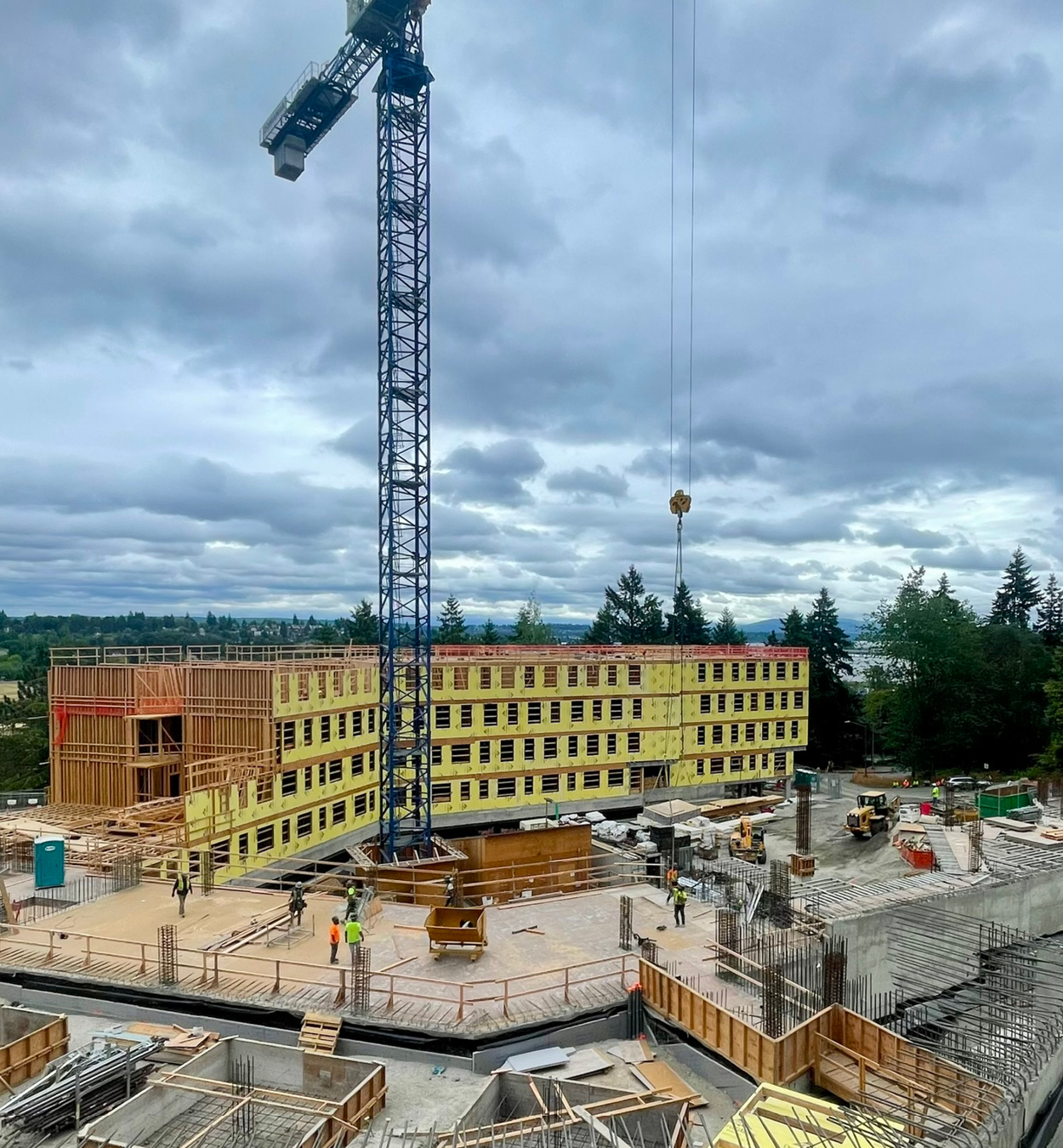
Accommodating 800 beds on the 2.5 acre steeply sloping site without pushing into costly high-rise construction required threading the needle between light frame construction limits, jurisdictional requirements, and UW Housing and Food Service’s programmatic necessities. The design team found that a stepped U-shaped building massing could successfully navigate the challenging grade, offer great views and daylighting, and maintain the highest level of fire access within mid-rise construction limits, avoiding significant cost implications of high-rise construction.
REIMAGINING CONVENTIONAL WOOD CONSTRUCTION
One strategy the team harnessed to build density cost effectively was to use Seattle’s code modification allowing 6-stories of wood construction when the first level of wood framing is 2-hour fire rated. Utilizing this unique Seattle code path allowed the team to reduce the height of the concrete podium on the east building wing, realizing significant cost savings and reducing embodied carbon emissions.
To gain more efficiency, Design-Build team members, including Mahlum, Coughlin Porter Lundeen, Andersen Construction, Superior Structures, and Engineered Wood Solutions, reimagined how conventional wood framing could be advanced to save time, materials, and costs without impacting performance.
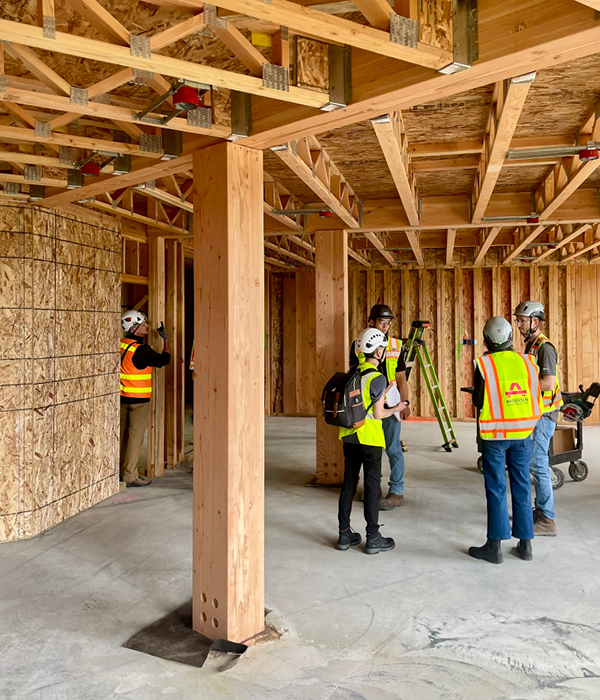
In addition to prefabricated wall panels, the next innovation involved using prefabricated wood floor trusses in lieu of standard engineered wood I-joists. These floor trusses, known as Trim Joists, proved incredibly helpful for distributing services in the rated floor-ceiling assembly without the need to custom drill countless penetrations through standard I-joists. Unlike conventional trusses, Trim Joists can be cut to size and incorporated with hangers to make installation fast and flexible. The BIM clash coordination phase was also greatly simplified due to the ease of systems routing.
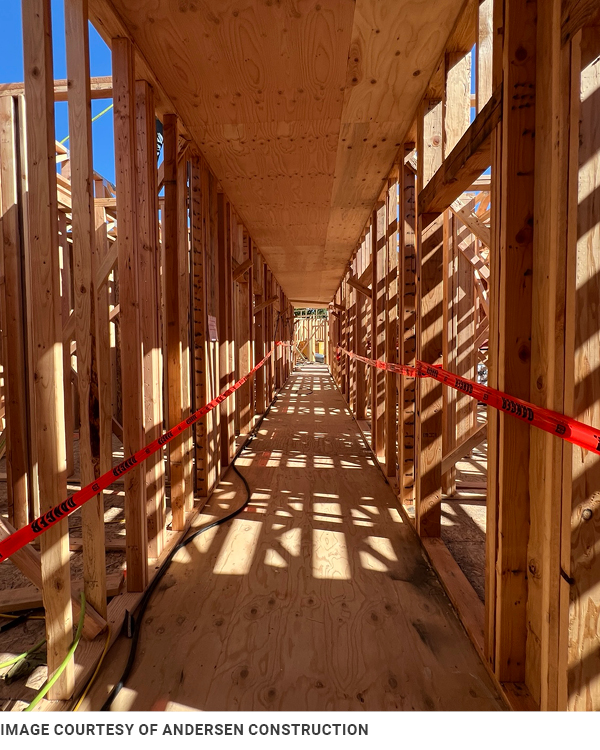
MASS PLYWOOD PANELS REDUCE TIME AND MATERIALS All spaces in Haggett Hall are provided with fully ducted fresh ventilation air. As such, corridors are densely packed with supply and return air ducting as well as other services. To provide uninterrupted space for these services and easy installation, the design team eliminated dimensional framing members running across the corridor. This innovation involved using mass plywood panels (MPP), a type of mass timber construction, to span the corridor with a thin structural panel without the need for support framing. The MPP was also designed to span in weak axis across the corridor. This design move allowed 40-foot MPP panel lengths to be installed running down the corridor, greatly saving erection time as compared to traditional tongue and groove (T&G) decking. The MPP panels can be sized to have inherent 1 or 2-hour fire rating through char, thereby eliminating time and materials often required to fireproof structural elements and saving space at the same time.
These innovations dramatically reduced the number of parts and pieces required for construction. This translated to huge time savings on-site. The construction team found that they could erect as much as 20,000 square feet of building framing per week – twice as much as typical wood frame construction and with fewer workers – another big savings. The Design-Build team plans to use and build upon this innovative system for future projects.
Click here to see a video showcasing the use of TrimJoist and Mass Ply Panels in the construction process. Visit the project page to read more about the development and strategy behind the replacement for Haggett Hall.